

 Back To Main Menu





Manual testing and automation testing cannot fully substitute for one another, and no tooling generation has changed that. Automation replaces execution effort; it does not replace judgment. Teams that budget for full replacement typically end up with a large suite, a maintenance backlog, and the same escaped defects they had before, because the defects automation misses were never the ones a script was going to catch.
The answer depends on two ceilings: the work automation cannot do, and the work it can do but shouldn't.
Manual Testing vs Automation Testing: What Each Is Built To Do
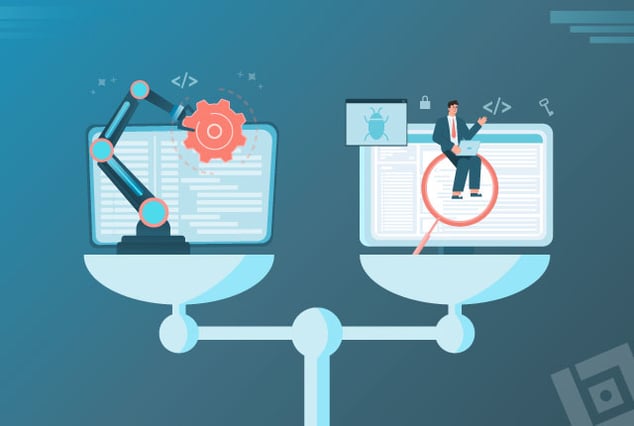
Both approaches exist to find defects. They are built to find different ones. Automation is built to confirm that known behavior has not changed. Manual testing is built to determine whether behavior is correct in the first place; a question that only has meaning when a human asks it.
| Behavior | Human-Led Testing | Automation Testing | AI-Assisted Testing |
|---|---|---|---|
|
Built to Answer
|
Is this behavior right?
|
Has this behavior changed?
|
Can we generate and maintain "has it changed" checks faster?
|
|
Best Applied To
|
|
|
|
|
Cost Behavior
|
Linear with scope, every cycle costs tester hours
|
Front-loaded into scripting, then recurring as maintenance
|
Lowers authoring and maintenance cost, but adds review overhead
|
|
Fails By
|
Inconsistency, coverage gaps at scale
|
Silent staleness, passing tests that no longer assert anything meaningful
|
Decide if behavior is right; it encodes existing behavior, right or wrong
|
For how to set the ratio between the two, i.e., what to automate first, when to shift the split, and how to sequence the investment, read Automated vs. Manual Testing: Right Balance in 2026.
Why the Full-Replacement Idea Took Hold in 2026
The replacement expectation is newer than the automation debate itself, and it formed from four pressures converging.
- AI-Assisted Development Changed the Volume, Not Just the Speed: When a large share of code is drafted with AI assistance, commit frequency rises and so does the regression surface behind it. The intuitive conclusion is that if code generation scaled, test generation should scale the same way and absorb the difference. This is where the replacement assumption starts.
- Regression volume outgrew manual capacity: There is an excessive amount of pressure with a legitimate core. A manual team can't re-verify a mature product on each commit, and there is no amount of hiring that makes up for that. At this stage, automation becomes the only effective solution to resolve regressions at CI/CD frequency.
- Boards started asking about it directly: "Why are we still spending money on manual QA?" is no longer an engineering question but one for the budget cycle. This question is asked with an answer already in mind.
A leader can respond by saying that manual QA is not doing the same work slowly. It is to fill the gaps that automation is structurally limited to cover. You can't eliminate cost by cutting it away; it's just pushed into production.
- AI-Driven Testing Platforms Matured: Testing tools can now assist with test generation, maintenance, prioritization, failure analysis, and even exploratory recommendations. As those capabilities landed, it became reasonable to ask which QA activities still require direct human execution, and it was easy to assume the answer was "fewer than before." The maturing of the tooling is what made full replacement feel newly plausible, even where it isn't.
The industry data does not support the conclusion. As per the report published by Coherent Market Insights in 2026, manual testing will dominate with more than 48% share. This is primarily because of its precision and the ability to uncover complex UI issues.
Adoption of automation and AI tooling is rising fast; displacement of manual testing is not following it at anything like the same rate. Rising adoption and steady manual reliance are not a contradiction. They are the direct evidence that the two are answering different questions.
What Automation Cannot Do, Regardless of Tooling
This is the hard ceiling, and it is a property of automated checks, not of how good the framework is. An automated test asserts against a defined expected outcome. Where no one has defined the expected outcome, there is nothing to assert against, and better tooling does not change that.
The following four categories sit above that line, either permanently or at the stage where it matters most.
Exploratory Testing
AI can expand exploratory coverage by generating scenarios, identifying anomalies, and suggesting additional paths. However, human testers remain important for interpreting unexpected behavior, understanding business context, and deciding which anomalies warrant deeper investigation.
Usability and User Experience Testing
Usability is a human judgment that is made about how an interface feels to use. It doesn't have a pass/fail definition to assert. These are perceptions, and only human beings create them. They could be intuitive, clear, frustrating, or reassuring.
Automation can confirm that an element exists and behaves as coded. It cannot tell you whether that behavior serves the user.
A script confirms a link is present in the DOM and that error handling returned a response. It cannot tell you the link is buried where no one will find it or that the error message leaves the user with no idea what to do next.
First-Run Features
A feature shipping for the first time has no baseline to regress against and no stable selectors to automate. Automating it costs scripting time against a spec that will change, and the defects that matter at this stage include wrong behavior, not changed behavior. These are exactly the ones automation is not built to find.
Ambiguous Acceptance Criteria
"Loads quickly enough," "reads clearly," "feels responsive," "handles this gracefully." These are all phrases that could be seen in real requirements, and all of them are true/false statements. They have to be interpreted at the human level as to what the threshold for the statement is. Once automation is configured to enforce it, it can do so, but it can't set it.
The through-line across all four is the same: automation verifies that behavior has not changed, while manual testing determines whether the behavior is right in the first place. A suite can be fully green against a product that is wrong, and it will stay green.

Where Full Automation Costs More Than It Returns
The previous section covered what automation cannot do. This one covers what it can do but shouldn't, i.e., the economic ceiling, which most teams hit well before the technical one.
- Maintenance Overtakes the Savings: Automated suites are code that carry the maintenance burden. UI changes and business logic changes break scripts. Past a certain suite size and change rate, the engineering hours spent repairing tests exceed the hours those tests save, and because the cost is distributed across sprints rather than appearing as a line item, it is usually invisible until someone measures it.
- Flaky Suites Destroy Their Own Value: When a suite fails for environmental reasons, the team gets used to re-running the tests. If a red build is deemed to be noise, then it stops being a quality gate for the suite, no matter the level of coverage it provides.
- Low-Frequency Paths Never Repay the Script: Automation economics are based on repetition. A workflow that runs two times in a year does not generate enough executions to justify the cost of its scripts and maintenance. The automation of that is a choice to spend more for the same coverage.
- Coverage Nobody Trusts is Coverage Nobody Uses: Suites collect tests that pass but say nothing of consequence. These might include failed assertions, overly mocked-up dependencies, and testing for a behavior that has been removed. Reported coverage continues to rise while real coverage is flat.
Can AI Close the Gap?
This is the version of the replacement question that is actually live in 2026. AI-driven testing absorbs part of the gap, which is the real part, but a specific and bounded one.
- What AI-Assisted Test Generation Absorbs: Test case generation takes away a huge proportion of the manual effort involved in building the suite. This is true, and it makes automating a certain task more cost-effective.
- What Self-Healing Absorbs: When selectors change, self-healing locators re-identify elements instead of failing the test. This attacks the maintenance burden described above, which is the most common reason automation programs stall.
- What Defect Prediction Absorbs: By analyzing code changes and historical failure patterns, AI can flag which areas are most likely to break and prioritize testing effort there. This sharpens where you spend limited testing time; it doesn't change what the tests themselves can judge.
- What Agentic Test Execution Absorbs: AI agents can now carry out multi-step test flows with less scripting, adapting to minor changes as they run. This extends how much execution can happen without a human driving each step, but it still runs against a defined notion of correct behavior, so it moves the execution ceiling, not the judgment one.
- What AI-Assisted Exploratory Testing Absorbs: AI can widen the exploratory surface by generating unusual scenarios and input combinations a tester might not have listed. It broadens what gets tried, but the defining act of exploratory testing, a human noticing something is off and changing direction to chase it, still comes from the tester. AI extends the breadth; the judgment stays human.
- What Neither Absorbs: Every one of these capabilities operates on an existing definition of correct behavior. Test generation, prediction, agents, and scenario expansion all infer what to check from what the application currently does or what a requirement states, so they will faithfully encode a wrong behavior as the expected one if that's what they observe. None of them decides whether the behavior is right in the first place, which is the ceiling this whole post is about.
The Net Effect: AI lowers the cost ceiling from the previous section without moving the capability ceiling from the section before it. More workflows become worth automating. The categories requiring human judgment do not shrink.
That is why AI adoption in testing and continued reliance on manual testing are rising at the same time rather than trading off. The two are answering different questions.
Conclusion
So, can automation completely replace manual testing? No. What will keep declining is repetitive manual test execution, the regression runs, and routine checks that automation handles better anyway. The judgment work, whether a feature is right, whether it makes sense to a user, or whether something looks off and deserves a second look, stays human.
That's why the real question in 2026 isn't manual versus automation. It's how you combine three things: human expertise, intelligent automation, and AI-assisted quality engineering, each doing what it does best.
The goal was never 100% automation. It's the right level of automation for your product, supported by AI where it adds value and backed by human expertise where judgment, context, and user experience decide the outcome. That balance is what QASource helps teams find, matched to your product's maturity rather than a template.