

 Back To Main Menu





Table Of Contents
- Understanding manual testing
- 11 reasons manual testing still plays a key role in 2026
- How AI changed manual testing (but didn’t replace it)
- When AI falls short: Scenarios when manual testing is the right choice
- Human-in-the-loop AI testing
- Best practices for effective manual testing
- Balancing manual and automated testing in your QA strategy
- Conclusion
Manual testing remains essential in 2026 because it brings human judgment, real-world validation, and contextual insight.AI will not be able to replicate edge test case creation completely. While change is imminent, normal, and healthy, manual testing isn’t going anywhere. It will be around for as long as the end users are human.
In the modern world, AI-driven test automation dominates QA. This is a position where you may assume that manual testing has become obsolete. Automation helps in running test scripts in seconds and pipelines more at lightning speed. However, there are still instances when software failures reach production.
According to the World Quality Report 2025-26, about 60% of businesses are struggling to establish security and compliance data sets. Further, 58% of businesses are facing multiple challenges due to automated AI-powered tools. This shows the importance of having a human-in-the-loop workflow when deploying AI for your testing processes.
To prevent user dissatisfaction and critical defects from slipping unnoticed, scripted automation tests won’t alone do the job. Manual testing continues to be the lens in quality assurance that covers the real-world judgment.
In this blog, we will explore everything about manual testing. We will learn why we still do manual testing in the world of automation.
Understanding Manual Testing
Whenever any new feature is added or modified in the application, there is a chance of breakage in the existing functionality. This may result in creating a bad user experience. The application should be verified from the end user’s perspective. It is always better to have such applications manually tested by domain experts.
Consider this: Will an automated testing service be able to test edge cases for a network switch that happens when traveling in the sub? Such minute cases are the key differentiator between delivering a satisfied user experience and a complete breakdown. With the decreasing attention span of the end users, businesses cannot afford even a single slip-up in their quality.
Expert manual testing services are able to imagine and execute complex business-specific scenarios that happen in the real world. This sort of rigorous, critical thinking is uniquely human, and it cannot (yet) be replicated by test scripts. Effective testing services are necessary to ensure that every business workflow is scrutinized from the perspective of the end users.
11 Reasons Manual Testing Still Plays a Key Role in 2026
Even with evolving technology, manual testing comes in handy. This section covers the top reasons where manual testing has the upper hand.
-
Increases Test Coverage
It’s nearly impossible to get 100% test coverage using automation testing. This is because there will always be a few scenarios that cannot be automated. Further, these would add to the cost of testing due to tool limitations or other complexities. For these scenarios, manual testing is the best bet.
-
Validation of User Stories
Manual testing is necessary to validate the functionality of user stories against the predefined documentation. Manual testing is necessary to implement features that align with the user expectations. A test engineer identifies these defects to ensure consistent functionality across automated tests.
-
Complicated Use Cases in Mobile Devices
Mobile devices bring up a complex testing challenge. Factors like switching Wi-Fi networks, multitasking, and answering calls have an impact on the app's performance. Further, there are variations in swipe direction and the number of fingers being used that add to this complication. Manual testing is best suited for this process because it allows testers to test the device from the user’s perspective.
-
Automation Inside Agile Relies on CI/CD Automation
Agile development does not complicate automation. Modern Agile workflows depend on embedding automation with CI/CD pipelines. Continuous integration requires fast and reliable regression validation to support frequent releases.
-
Reduces Costs
Thinking about automating testing at the initial stage of development? This could add to the cost of your testing, because teams will need to learn the product and build the automation framework. It is recommended that you rely on manual testing for verifying new features. Continue with the process until the product is in a stable enough state for automation. It’s a move that will save you both money and time!
-
Steer Clear of Last-minute Bugs
There will be times when the release date is drawing near, and a new bug jumps into the mix. This is most likely due to the hotfix of another bug. Instead of letting this be a show-stopper, a manual tester can help find a quick workaround that helps keep the release on schedule. This is impossible with automated testing, because it relies on scripts and predefined behavior.
-
Test in Real Time
Some test simulations cannot be achieved using automation testing. There are cases where test scenarios, like tracking the location of any object, need to be executed in a real-time environment. Such tests can only be accomplished with manual testing.
-
Validating AI Outputs
AI systems can generate recommendations, classifications, and predictions based on training data and models. In fast sprint cycles, new features evolve continuously. Manual testing will ensure functionality before automation scripts are finalized and integrated into CI/CD pipelines. Human validation is necessary for identifying bias or contextually inappropriate responses.
-
Reviewing AI-generated Tests
AI tools can generate thousands of test cases. However, this quantity does not guarantee relevance. Manual testing is necessary to eliminate redundancy. These testers validate business alignment and ensure coverage with real user journeys.
-
Spotting Hallucinated Cases
AI models can produce scenarios that do not accurately reflect the required system behavior. Manual testers will help in identifying the hallucinated outputs. They prevent them from automating invalid assumptions in irrelevant test paths.
-
Interpreting Business Impact
AI may detect anomalies or defects, but it cannot prioritize them on the basis of business context. However, manual testing will evaluate the operational and financial implications of issues. This is necessary to identify the defect severity rather than technical detection.

How AI Changed Manual Testing (But Didn’t Replace It)
Artificial Intelligence has transformed the way manual testing operates. AI-driven tools now assist with defect detection, regression prioritization, and impact analysis. The different methods in the modern QA environment include:
- AI Generates Test Cases → Humans Validate Relevance: AI can generate thousands of test cases. However, manual testers will evaluate if those scenarios align with real user journeys and business priorities.
- AI Runs Tests → Humans Interpret Risk: AI-based execution alone cannot define severity. However, manual testers understand patterns and issues that pose genuine risk to end users.
- AI Finds Defects → Humans Assess Business Impact: Although AI finds defects, not every defect is critical. Manual testing is necessary to ensure customer experience and operational risk.
- AI Lacks Contextual Understanding: AI systems completely rely on patterns and probabilities. Manual testers provide context related to brand reputation or customer sentiment.
When AI Falls Short: Scenarios When Manual Testing Is the Right Choice
In this section, we will talk about the scenarios where manual testing is a better choice. Although automation accelerates execution, manual testing delivers value when it comes to critical scenarios.
- Early Stage Development: When you are in the early stage of development, requirements often change quickly. With manual testing, you can allow testers to validate functionality without building overhead. Further, at this stage, automation scripts become obsolete a bit too soon.
- Ad-hoc Testing: When the goal is more about discovery rather than confirmation, manual testing is more effective. Manual testers can uncover edge cases and assumptions that automation scripts are not designed to find.
- User Experience Validation: When you need to assess how the end user will feel about a certain feature, manual testing is your go-to option. Manual testers will evaluate the software the same way real users will. This helps in identifying friction points that may go unnoticed by automation scripts.
- Complex Scenarios: Manual validation is beneficial when involving applications having complex business logic or data interpretation. Manual testers can evaluate outcomes holistically and identify inconsistencies.
- Short-term Projects: In situations like one-time releases or infrequently used features, manual testing is effective. This is because manual testers complete testing faster and require less infrastructure coverage.
- Real-world Testing Conditions: Manual testing is particularly useful when validating real-world conditions. This includes varied devices, network fluctuations, and user behaviors. Manual testers have the ability to respond to unexpected events, unlike automated scripts.
Human-in-the-loop AI Testing
“Automation is fast. Automation is powerful. But automation does not think.”
Modern manual testing operates in an AI-augmented ecosystem. Human-in-the-loop AI testing ensures automation remains accurate and relevant. They ensure alignment with business objectives.
Manual testers today:
- Validate AI-generated test scenarios for business relevance
- Audit automation coverage gaps to prevent blind spots
- Check hallucinated outputs and remove misleading test cases
- Interpret model-driven results within operational and customer context
- Ensure ethical and accurate product behavior
Best Practices For Effective Manual Testing
Manual testing is effective when it is executed with intent, structure, and discipline. In this section, we will discuss the best practices for manual testing. By following these best practices, you can achieve consistency, deeper coverage, and meaningful insights.
- Start with Clear Objectives: Manual testing begins with an in-depth understanding of business requirements. It also includes understanding your user journeys and risk areas. It is necessary to ensure that test scenarios are aligned with real user behaviour. The focus should not be solely on functional specifications.
- Prioritize Risk-based Testing: Manual testing should be focused on core workflows, features, and integrations. Ensure that the specifications you choose are critical to the user experience. This means that human effort is applied right where the defects would cause the greatest damage.
- Strategize Exploratory Testing: Make sure that exploratory testing is intentional, not random. Manual testers should explore features with defined goals and refine the test path based on observations.
- Maintain Documentation: Transparency and clear documentation help in improving repeatability and knowledge sharing. Documentation helps testers track coverage and ensure they do not miss any scenarios.
- Think from the User’s Perspective: Manual testers should think beyond their expected outcomes. They should consider how real users will interact with the software or feature. This includes assessing clarity, accessibility, ease of use, and the overall experience.
- Collaborate Closely With Stakeholders: Frequent communication with both developers and stakeholders reduces rework. You can strengthen the entire development lifecycle by sharing insights, patterns, and usability feedback.
- Consistently Upskill Manual Testers: Manual testers also need upskilling. They should have strong domain knowledge and familiarity with AI tools. This is highly necessary to stay relevant in today’s landscape. Continuous training ensures that manual testers add value to the process and not just execution support.
Balancing Manual And Automated Testing In Your QA Strategy
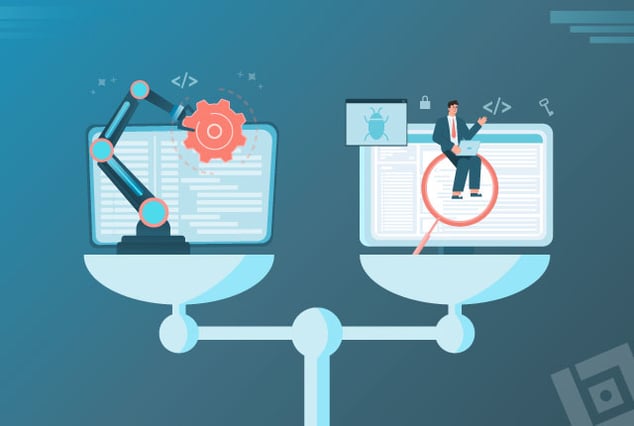
Businesses are often left with the most challenging option to choose between manual testing and automated testing. The most effective strategy in such a situation is to combine them both. The table below will help you make an informed decision.
| Factors to Consider | Manual Testing | Automated Testing |
|---|---|---|
|
Best Use Case
|
Most suited for situations that require creativity, judgment, and decision-making
|
Most suited for repetitive, high-volume, regression testing
|
|
Strength
|
Exploratory testing, usability testing, and testing of frequently changing features
|
Faster execution with consistent results for repeated test runs
|
|
Key Impact
|
Identifying risks, usability concerns, and unexpected issues that automation may miss
|
Identifying failures in predefined workflows repeatedly
|
|
Role in QA strategy
|
Serves as a quality advocate for validating real user experience
|
Ensure speed and stability in the overall process
|
|
Maintainence
|
Adaptable and easy to adjust as per changing requirements
|
Regular update needed when there are changes in the UI or logic
|
|
Approach
|
Useful where a human approach is needed for adding maximum value
|
Useful where speed and repetition are necessary
|
|
Success Factor
|
Continuous evaluation of test coverage
|
Continuous alignment to ensure efficient and relevant automation efforts
|
|
Outcome
|
Improves usability, accessibility, and real-world practicality
|
Ensures faster releases and supports your CI/CD pipeline velocity
|
Teams that build the right balance deliver reliable and usable software with ease. Such software turns out to be practical in real-world conditions with ease of use and high accessibility.
To understand how you can combine automation with manual testing, read our blog on The Right Balance of Automated vs. Manual Testing Service
Conclusion
The future of software testing is not manual testing vs automated testing. It is a combination and a fine balance that has to be built intelligently. Automation brings speed and scale. It is manual testing that brings understanding, judgment, and a real-world perspective.
Businesses that understand the real impact of manual testing build QA strategies that are resilient and cost-effective. To put it simply, defects need not be identified faster. The aim here is to build software that works for the people.